 After that was sushi: the first time we’ve eaten sushi since arriving in Japan (I’m not counting the sushi we ate in the kitchen at “Grand Chef Suzuki’s” tasting demo...as a waiter, and I think as a chef, food eaten standing up doesn’t count. Which is probably why we all pack a few more pounds than we might need to.). I think Sho-san really wanted to impress upon us the fact that JAPANESE CUISINE DOES NOT EQUAL SUSHI, and we got it. We really did. This trip has completely changed the way I look at food, though it’s too close to the trip to really say how just yet.
The best sushi (I thought) was the uni, which tasted like fresh, refined sea water, but super creamy. We also had a crazy red clam that was moving, and a white fish that was blowtorched and squeezed with lemon (TACHIUO, ‘scabbard fish’), not to be eaten with soy sauce. Also great and really fresh was a sardine.
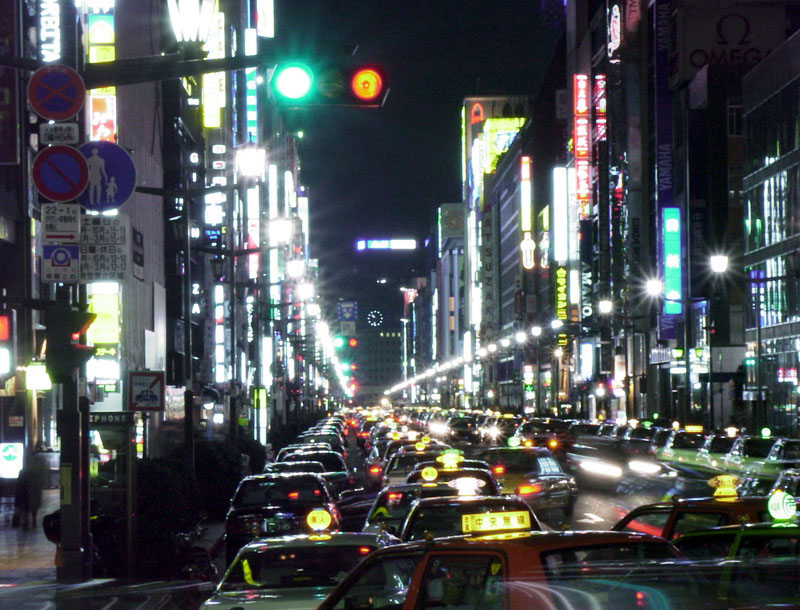
One thing that's really interesting about this part of Ginza is the little streets and places full of character that when viewed from the outside lend this crazy party atmosphere to the streets. They’re all festively decorated and there are lots of people going in and out, and the energy of people eating and drinking and having a good time surrounds them all. Then, when you (literally) duck in, it’s a different world, and much more approachable. Real people, doing their after-work thing, and you could never even begin to try the food at all of them, though we did our best. We ate at least four meals a day, every day in Japan and most days we had a full dinner at one place and then went to another for a second dinner.

The kinds of conversations the chefs were having about food almost seemed to make the world smaller. Think about it: cross-culturally, the heart and soul of food is the same everywhere. Things are skewered, they’re stewed, they’re stuffed. One thing we’ve all really liked about the back-room, family-style food we’ve been eating in Tokyo has been that that food has not taken the foreground. We’ve all been eating constantly, obvio!, but the kind of food we’ve been eating: simple, soulful, smoky (the “smoky” restaurants Sho-san referred to in an email early on was not regarding cigarettes, but rather the wood smoke filled with meat smells and pork fat that permeates everything), has not evoked the restaurant critic in any of us. Rather, it’s provided a great background for conversation and the ambiance of the evening and great fuel for creative thoughts that obviously revolve around food.


 First, the rice is polished to remove the exterior of the rice grain (where protein and oil live), and the “pure core” of the rice is fermented. The more rice is polished away, the more high-quality the finished sake will be.
 After the rice ferments, it is pressed, and the liquids separate from the solids. Some sake has distilled alcohol added: this sake is called honjozo-shu, and is the cheap warm sake that many Westerners remember as their introduction to sake. After filtration, the remaining lees are removed (except in the case of nigori, where it is left in the sake to add a sweet taste and a creamy texture), and the sake is filtered and pasteurized (in most cases). Then, the sake rests and is diluted with water to lower the alcohol content and is bottled and drunk.


 There were only two chefs that ate every bite: Damon, and Ravi, and Shotaro did his best but by his last dumpling he was sweating and couldn’t eat dessert. But the presentation was lovely and I really enjoyed opening little bowls to see what was inside, especially the the main course, several pieces of thin-sliced Sendai beef that had been wrapped around different vegetables and steamed inside a bamboo tree trunk with river rocks that kept the beef elevated above the bottom of the slice of trunk so that the fat could drip down.So when I got on the bus today for our excursion to the sake brewery and then to the oyster farm, I hadn’t eaten anything and I was still feeling uncomfortably full from the day before (we had attended a ‘processed seafood tasting’ where we had to give feedback on several different kinds of frozen, smoked, dried seafoods; then we’d gone to a panko place and eaten fried things for hours; Bruce and Damon and I stopped after 9 or 10 skewers but the others went on and ate 17 skewers) and I was nervous about the meal.
  Yesterday was kind of an overwhelming day, food-wise, with a traditional Japanese breakfast in the morning, then that killer lunch that went on for hours and then all the fried stuff. I was not feeling well.The lunch we had was the perfect size and all the flavors were great. I was honestly scared of eating! but the sashimi was so fresh and the flavors were so perfect that I ate almost everything presented to us. There was a sashimi course, some pickles, miso soup (with seaweed from the lake that we were sitting on), local Miyagi rice which was amazing, for a bowl of plain white rice it had so much character and was really tender. The main course was miso-glazed mackerel that had been cooked for a long time and had a butter burr, sancho and miso paste on top and a little bite of cherry custard to the side.I loved the custard dish Cha Wan Mu Shi, which was egg and dashi steamed inside a teacup; with a little hidden piece of something (yesterday it was a shrimp and a piece of chicken, that custard was broken and the serving was too large) inside of that. Then we had slices of a delicious little thing, a couple pieces of fish wrapped in a shiso leaf and then wrapped in a skin of rice flour and egg yolk and deep fried.
 Dessert was a tiny scoop of cherry-leaf ice cream that had been flavored with strawberries as well. Sendai strawberries are some of the nicest I’ve ever had.

 The bidding market was amazing. I rolled out of bed late, after having slept less than two hours and having drunk all of the beer in my mini fridge and stumbled down into the lobby with my sunglasses on at 5:45am. We got into our bus with doilies (all of the vehicles here have doilies on some parts of them, our bus has doilies where people’s heads rest) where the mayor was waiting for us. We arrived to the market and changed into our white rubber boots and flourescent pink trucker hats that had “Sendai” printed on them and walked along a catwalk
 above the bidding. I wish I had better words to describe how the auctioneer and the bidders sounded: an auction sounds funny in one’s native language as there’s a very specific intonation used by the people involved...in Japanese it sounds even funnier because the noises are so different. And I think Japanese sounds very ‘cute’ anyway, I like the short sounds and the way that vowels are drawn out, and the “HAI!” of agreement. It seems like people say things with as few words as possible, which seems very efficient to me. Down on the bidding floor, I was very happy to have been issued the flourescent pink hats (though sadly I was not allowed to keep mine, it would have been an awesome souvenir) as there were hundreds of people milling about, all with white boots, all looking at the fish as intently as we were. I enjoyed especially identifying some of the fish we had eaten the night before, and looking at the cuddly-looking Fugu swimming in shallow pans.This is a wholesale market, so it was interesting to see where the fish that consumers see in the fish market or the farmers’ market comes from.
  There were big prawns with their heads on and eggs in many colors stuck to their legs (some had green eggs, some had yellow eggs), and the huge tuna all lined up on the floor, that would be hooked through the mouth and wheeled away when they were bid on.Each tuna had a number painted on it, and potential buyers got there very early before the auction even started at 6am (they arrived at 4:30 am) to check with their own eyes the fish before bidding on them.
  The fish were absolutely gorgeous, all had their tails cut off, I think so potential buyers can see grade of the meatIKIJIMI is the method used of killing the fish, in which the gills are cut after the brain is spiked and then they cut the tail off to grade the meat. This method of killing stops all movement in the fish, so the meat does not get bruised by flopping around. Also tuna is the only warm-blooded deep sea fish so getting the blood out quickly keeps the meat from producing enzymes after death that would turn it brown.
 We visited a cutting table that had one man who had been cutting for 30 years, his boss had been cutting for over 40 years. Watching him cut with the two different kinds of knives was interesting; he de-boned an almost 200-lb bluefin tuna (the biggest at the auction was about 220lbs) with an effortless grace that belied the fact that he was basically wrangling a barrell.
 We had a really special treat: the maguro cutter sliced off pieces of tuna for us right there and somehow chopsticks and soy sauce and a plastic plate appeared, and us carnivores dug right in and felt as though we’d hunted something.


 It’s a myth that the cows are massaged, but they are fed beer if they’re not feeling well to give them energy.In 1973, growth hormones were banned in Japan. If growth hormones are used, the beef grows too fast to have a lot of fat marbling. It smells good at the beef ranch. There’s cedar sawdust on the floor and the beef (all male, all with their horns) are very calm as they greet us. They are not agitated like American cows and they kick their poop out of the back of their pens. There are five beef per pen and they have plenty of room.
 When my (now) ex-boyfriend was visiting me in California for the first time, he and I drove from San Francisco up to Healdsburg for the weekend to meet my family. He’s Argentinean, and his family had a large estancia where he spent weekends and summers growing up. As we drove through southern Sonoma County, where the dairy cows are kept, I rolled up my window as normal to block out the rancid cow smell.Che nearly gagged at the smell coming through the closed air-vents. “Don’t worry,” I told him. “We’ll be through this area in just a few minutes. It doesn’t last very long.”

 We were given a presentation on miso's origins (made in this spot under a feudal lord for centuries, then 400 years ago was 'liberated' to the public) and on how it's made (soybeans are cooked and koji mold and salt are added, then the starter ferments for different lengths of time: white miso is the mildest and ferments only a few months, while at the other end of the spectrum black miso has an incredibly extracted taste after 2.5 years of fermentation).
 Everyone scrubbed up (white suits and white hairnets) and trouped onto a catwalk to peer through the windows onto the floor below, where we unfortunately weren't allowed.
  The factory was almost reminiscent of
  One of the best things about traveling with a group of talented chefs (and there are many) is that every conversation turns into a think tank. Listening to them talk about different ways they'd use miso was fascinating--making a meat


