Wednesday, May 06, 2009

Blue Bottle is Taking Over the World


When I first moved to San Francisco, a bike messenger friend turned me onto the best coffee I'd ever had, which could be found in a little alleway in Hayes Valley, in the garage behind an architecture firm. 
Everybody knows that Blue Bottle coffee has taken off since then, and their latest venture is inside the MOMA's new rooftop sculpture garden. The sculpture garden is on top of the parking garage so it's not actually inside the MOMA, it's connected to the fifth floor via an enclosed walkway, and the space that Blue Bottle is inside is all windows, so the garden, and the sky, and the city, can be viewed from inside on a rainy 
day (like this morning was).  
The nice part about it not being completely connected is that you can still go up there if the fifth floor is closed for an installation, which it often is.

The garden has been really well designed to showcase the art there, which seems like a no-brainer (it's an art museum, after all) but so often museum architecture can be show-offy, which takes away from the art itself. At the press preview, the line was out the door for espresso at the Blue Bottle counter. Expect it to be longer when the MOMA opens the rooftop garden to the general public this Sunday, which is free of charge.

Tuesday, April 14, 2009

I've got something to say


For the next six weeks, every Tuesday I'll be opening my big mouth on on 7x7's "Bits and Bites" blog. Topics will vary but will always have to do with "how to be a better diner." If you have any ideas for what you'd me to write about, please leave them here!
eet smakelijk,
Restaurant Girl

Monday, March 30, 2009

Last Night in Tokyo

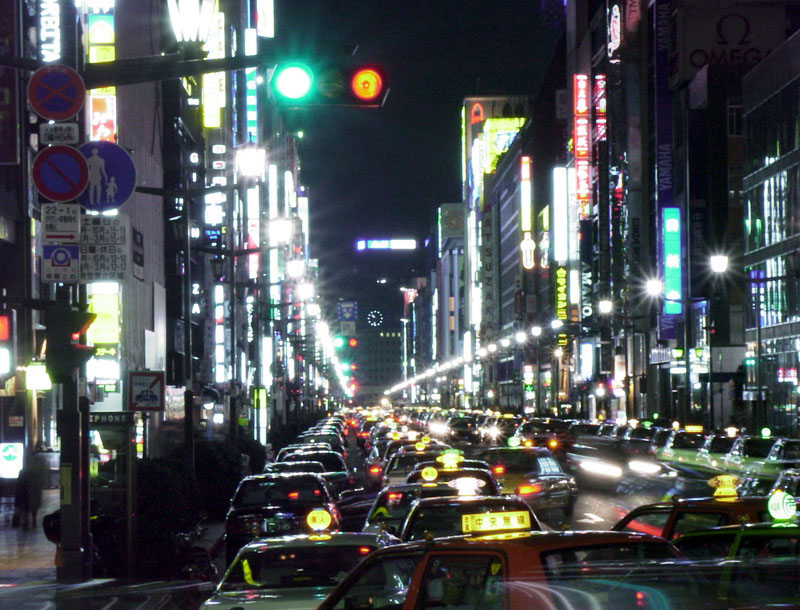
Wandering through Ginza on our last night was like being in Barcelona: a drink and a skewer here, a beer and a chicken ball there. First we went to a place that had exactly enough seats for all of us, and had some skewers of pork stomach, pork belly, and pork intestine, and really tender braised tripe, the leanest meat I’ve had so far on the trip, which says a lot about the richness of Japanese meats. I’ve really garnered an appreciation for meat fat here that I didn’t have before. I hope I impressed my chefs!Then off to a second place with a very strict mama-san (we didn’t have Jiro around to warm up the Mama-sans any more and we all missed him sorely) who spoke great English and served some tender chicken tail (a part of the chicken I never even knew existed), and some little peppers that were like Friuliano peppers that we’ve been seeing the whole trip. The place was literally built into the bridge that the city train ran over, so every time a train passed overhead (about every 2-3 minutes), it sounded like there was a taiko drum festival in our honor.
After that was sushi: the first time we’ve eaten sushi since arriving in Japan (I’m not counting the sushi we ate in the kitchen at “Grand Chef Suzuki’s” tasting demo...as a waiter, and I think as a chef, food eaten standing up doesn’t count. Which is probably why we all pack a few more pounds than we might need to.). I think Sho-san really wanted to impress upon us the fact that JAPANESE CUISINE DOES NOT EQUAL SUSHI, and we got it. We really did. This trip has completely changed the way I look at food, though it’s too close to the trip to really say how just yet.
The best sushi (I thought) was the uni, which tasted like fresh, refined sea water, but super creamy. We also had a crazy red clam that was moving, and a white fish that was blowtorched and squeezed with lemon (TACHIUO, ‘scabbard fish’), not to be eaten with soy sauce. Also great and really fresh was a sardine.

One thing that's really interesting about this part of Ginza is the little streets and places full of character that when viewed from the outside lend this crazy party atmosphere to the streets. They’re all festively decorated and there are lots of people going in and out, and the energy of people eating and drinking and having a good time surrounds them all. Then, when you (literally) duck in, it’s a different world, and much more approachable. Real people, doing their after-work thing, and you could never even begin to try the food at all of them, though we did our best. We ate at least four meals a day, every day in Japan and most days we had a full dinner at one place and then went to another for a second dinner.

It’s been really great listening to all of these chefs put their heads together and talk about different projects they could potentially do after being so inspired by this trip. Getting to see and eat all of the things we did, things that no ordinary tourist would ever even dream of doing, was an experience impossible replicate. As a travel writer, and someone who travels a lot even when NOT writing about it, it’s very rare that I get to just sit back and not make any decisions, and to have had a trip of this caliber without having planned any of it myself...I was REALLY impressed. And it was many of our first time to Japan.

The kinds of conversations the chefs were having about food almost seemed to make the world smaller. Think about it: cross-culturally, the heart and soul of food is the same everywhere. Things are skewered, they’re stewed, they’re stuffed. One thing we’ve all really liked about the back-room, family-style food we’ve been eating in Tokyo has been that that food has not taken the foreground. We’ve all been eating constantly, obvio!, but the kind of food we’ve been eating: simple, soulful, smoky (the “smoky” restaurants Sho-san referred to in an email early on was not regarding cigarettes, but rather the wood smoke filled with meat smells and pork fat that permeates everything), has not evoked the restaurant critic in any of us. Rather, it’s provided a great background for conversation and the ambiance of the evening and great fuel for creative thoughts that obviously revolve around food.

Wednesday, March 25, 2009

Ichinokura Sake Brewery


Growing up in Northern California, one has a pretty good grasp of how wine is made. I was glad to have this background when visiting the Ichinokura Sake Brewery on our third day in Sendai City, because I would have felt a little lost in this huge plant. For many Americans, an introduction to sake came while dining at a sushi restaurant. A ceramic pitcher of hot, high-alcohol sake arrived, it washed down the sashimi and the nigiri in little cups, and we thought that all sake was the same. That’s a little like drinking a glass of white zinfandel straight from a box and thinking that all wines are pink and sweet.Sake (which is technically a beer, because it’s brewed and is derived from a grain), is often compared to wine because of its alcohol content (higher than a beer at around 16-20%) and because it works so well paired with food.
Sake’s flavor elements come from simple ingredients and a complicated process. The biggest factors that influence the finished product are water, rice, and yeast; other factors that have a hand in the sake’s flavor are weather and geography.
Sake is produced by fermenting rice. First, the rice is polished to remove the exterior of the rice grain (where protein and oil live), and the “pure core” of the rice is fermented. The more rice is polished away, the more high-quality the finished sake will be.
The rice is then soaked and washed, then cooked and fermented by adding koji and yeast (which change the starch into sugar, and then the sugar into alcohol) for several weeks. Koji is a mold that converts the rice’s starch into a simple sugar, which feeds one of many varieties of sake yeast to begin fermentation. The fermentation is often slowed by lowering the temperature; either by refrigeration or in snowy winter climates.After the rice ferments, it is pressed, and the liquids separate from the solids. Some sake has distilled alcohol added: this sake is called honjozo-shu, and is the cheap warm sake that many Westerners remember as their introduction to sake. After filtration, the remaining lees are removed (except in the case of nigori, where it is left in the sake to add a sweet taste and a creamy texture), and the sake is filtered and pasteurized (in most cases). Then, the sake rests and is diluted with water to lower the alcohol content and is bottled and drunk.

There are several different classifications of sake, with the most important being:

Junmai-shu. This is "pure rice sake," made from only rice, water and kōji, with no other additions.

Ginjo-shu is made from rice polished to 60% or less of its original weight. Sake made from rice polished to 50% or lower is called daiginjo-shu.
The term junmai (“pure rice sake”) can be added to ginjo or daiginjo, resulting in junmai ginjo and junmai daiginjo.
Sake can be served chilled, at room temperature, or heated, depending on the preference of the drinker, the quality of the sake, and the season. Hot sake is usually drunk in the winter, and high-grade sake like junmai daiginjo and junmai ginjo are not drunk this, because their delicate flavors and aromas will be lost through heating. Sake is often heated to hide the flavor of low-quality sake.
Aside from being served straight, sake can be used as a mixer for cocktails, like a “saketini” or a “sake bomb.”

Sake is best consumed within 2 or 3 hours after opening the bottle. It can be stored (in the refrigerator), although it is generally recommended to finish the sake within 2 days.
Needless to say, we drank a LOT of sake in Japan. 

Current Obsession: MUJI

CURRENT OBSESSION: MUJI
Japanese minimalism and perfect design meets sustainability
I’m currently obsessed with the minimalist eco-designs from MUJI, which translates from the Japanese into “No Brand.” I first discovered it in Sendai City on a food tour with a bunch of chefs. We’d been out to a super-homey yakitori (skewered meats roasted over an open charcoal grill) restaurant the night before, and our host had pointed out the groovy aprons that the yakitori chefs were wearing (in addition to dish towels wrapped around their heads, a standard here in Japan).Sho-san (our Japanese host, who lives and works in San Francisco) told us he’d take us to a place where we could get the same aprons for cheap, and the next day we went to MUJI, on the ground floor of a shopping mall (where it seems everything cool in Japan is located). MUJI is like a Japanese Ikea but with clothing: everything you could possibly need for home, body, and travel, but designed well, and it’s all made out of organic cotton and other sustainable fibers like bamboo.
At the end of the food tour, after our flight home from Tokyo to San Francisco was unexpectedly cancelled, we realized that we’d all brought just enough clothes to last us for an eight-day trip, not the nine-day trip we were suddenly faced with. Most of us had been wearing the same clothes juuuust enough to keep the funk at bay. The chefs didn't really care; a couple of them had bought a new pair of socks  or a new t-shirt (stinky boys!) but I couldn’t face the thought of wearing the same clothes for the (x) day in a row.

As the chefs were tucking into yet another fried meal in a mall (this time in Tokyo), I noticed another MUJI. We'd blown through the first store in a whirlwind, picking out aprons and chopsticks with a determined speed, and while I had bought my aprons with the intent of wearing them as modified dresses when getting back to San Francisco (they’re cute and well-designed, two hallmarks of Japanese culture that I’ve discovered, and fell in love with this week), I hadn’t really taken a look at all that MUJI had to offer.

I could have stayed in there for much longer than the hour it took for the chefs to come wondering where the hell it was I’d got to. The clean lines and lack of any distinguishing labels brought to mind the understaded chic of Yoji Yamamoto, and the amount of things available was mind-bogglingly typical of the quality of goods that the Japanese consume on a regular basis. What drew me in first was a series of well-cut striped shirts, and a linen shirtdress with a pintucked tuxedo front fit just right.
MUJI's prices are low: for $160 USD, I left there with the shirtdress and tights, a pair of grey leggings and a pair of striped socks, a striped longsleeve T, a pair of flat black booties with round toes and only four shoelace-holes that I don’t think we’d see the likes of outside of Japan, and those were only the clothes. 

MUJI also equipped me with a selection of travel accessories that I haven’t been able to find anywhere else and have been looking for in all one place for years. Sure, there’s the Eagle Creek packers and the Rick Steves luggage dividers and the racks of German-made ergo-design stuff that you’ll find in the outdoors-equipment stores, but MUJI’s toiletries bags and packing inserts are made of the finest, lightest-weight nylon that squeezes down into wispy little balls of nothing yet can zip tightly around six pounds of dirty laundry (I know, I squeezed all mine in the second I got my brown-paper recycled MUJI bags back to the hotel’s concierge, where all of my luggage had been in stasis since we returned from our futile journey to the airport the day before).

Maybe I’m just an organizational freak, but a frequent traveler often has their rituals and their weird little tics that they can’t live without: mine are an oversized pashmina scarf, a series of earphones, eye-masks, and writing materials and several little bottles of in-air moisturizing liquids that keep me from suffering and prevent jet-lag once I’m on the ground. All of these are now neatly arranged into easily accessible little corners of my purse in black-and-white checked bags that weigh under an ounce each and are designs worthy of the Comme des Garçons label.

There’s a few MUJI stores in New York City, but the across-the-pond prices have inflated and there was just something about buying it all in Japan that really satisfied that “I got something that’s completely utiliarian and that I can’t find anywhere else in the world” itch.
Wait, am I the only one who has that itch?