
Tuesday, August 16, 2011


Monday, July 18, 2011
A lovely weekend at Milliken Creek
This last weekend, my fella and I were invited to stay at Milliken Creek Inn, which is right on the Napa river. Those of you who are already familiar with my stories might know that I'm not the biggest fan of Napa, finding it overcrowded with drunk tourists and cheesy tasting room employees, so I was skeptical of this invitation, but wanted to escape the San Francisco fog.
 How wonderful it is to know that there's still rustic charm in Napa! Milliken Creek Inn sits right on the river, which is a tide river, ebbing and flowing from both directions. There are several buildings on the property, which originally housed a tavern that stagecoach riders would stop at on their mail routes in the 1800s.
This was the first weekend away the Mister and I had since we were married last October, and Milliken Creek was such a sweet place--they are all about the romance. The Inn's lovely general manager ticked off the personal butlering services she's done for the Inn's guest over the past year: organized plane-writing in the sky for an anniversary, a butterfly release, bought lingerie, and procured a special bottle of wine of which there were only 10 left in the world. She joked, "The only thing I won’t let someone do is fish off my river bank!" (and you wouldn’t want to, nor would you want to swim in the river).

We dropped our bags off in the luxe room and headed into town for some oysters and beer at the Oxbow Public Market, wandered around the Ferry Building-esque food court and came back to the Inn for a spa treatment--one of the best this cynic has ever had. The line they use for facials is Eminence Organics, which I'd never heard of but is definitely on my list of skincare to recommend.
Although the Inn kindly offered to make us a reservation anywhwere in Napa, we didn't feel like dining out and so bought all of the fixings for our favorite picnic dinner (baguette, boquerones, prosciutto, soft cheese, cornichons, and a 12-pack of Pacifico) and ate on our private deck.
 The morning brought a cute picnic basket packed with a hot breakfast (you order it the night before by hanging a tag on your door and they deliver it starting at 8am) and the daily papers.
I'd definitely recommend a stay at Milliken Creek for any couple who's looking for some romance, especially since the Inn is celebrating their 10-year anniversary this year, and offering special packages that include a driver, dinner reservations, chocolate and strawberries (um, did I mention they covered our entire room with candles, roses, and rose petals while we were enjoying the 6pm Winemaker Hour in the Inn's lobby?!?), and a few frisky treats that couples can indulge in when they come back to their room in the evening.
The packages range from $900-$1200 for the 2-night package, and regular room rates depend on the season, from $275 for a “Milliken” room in the off-season to $650 for a luxury room during the high season.

Saturday, April 09, 2011
So Much Sake
Over 500 people showed up for the Japan fundraiser at Yoshi's this afternoon. Chef upon chef outdid each other with offerings of internal organs prepared in just the right proportions...and the live jazz made all the food that much more savory.


More to come...


More to come...
Tuesday, April 05, 2011
Chefs United Raised $42K for Sendai

Sunday night's fundraiser at Prospect was by all accounts a smashing success, we raised $42,000 for the people of Sendai City and Miyagi prefecture, and it seems that folks had a great time.
Longer post to come, for now I've got to prepare for Saturday's event at Yoshi's! (Buy tickets here)
If you're looking for posts about the trip to Japan that the hooligans above took in 2009, you can find them HERE.
** Update**
A little more about the fundraiser on Sunday night:
Each of the chefs that I visited Japan with (pictured above) created a dish inspired by our trip to Sendai in 2009. They each gave their dish a name--the word that reminded them the most of Sendai.

Prospect opened its doors on a Sunday night, which is huge for a restaurant, so many many thanks to all of the waiters, bartenders, and amazing cooks who (I'm assuming) worked tip-free (which is basically for free) on Sunday to bring this menu to the 120 diners that showed up in support of the Miyagi prefecture.
Each course was paired by the chefs and their team with a different sake or wine (all donated, as was much of the food--the Albarino Amy Currens procured for Chef Ravi's asparagus/crab/uni dish was especially refreshing) and all were made with ingredients from Miyagi like Matcha (Lissa Doumani's delightful green tea and strawberry dessert), Sendai red miso, and Miyagi oysters. Having visited the farm where Miyagi oysters come from has given me such an appreciation for them, as we see them on most restaurant menus worth their salt in San Francisco.

Tuesday, April 27, 2010
No Words Minced at Quince

Okay, so I just wanted to have a snappy title for a post about dining at Quince. But words *weren't* minced at the Oregon Certified Sustainable Winemakers' dinner last Tuesday, where a select few Oregonian winemakers showcased their current releases.
 When I hear "biodynamic" or "organic" wine, the word "sludge" flashes through my brain before it can help itself. It's unfortunate that the biodynamic/organic label can carry negative connotations in the haute wine world. Just as some of the city's best restaurants will use organic, local food and utilize green business practices--and not tout it--many of my favorite Californian wineries farm organically and produce their wine biodynamically, without making a big deal on the label. (Quintessa and Unti come to mind).
Adelsheim Vineyard's and WillaKenzie's Pinot Blancs were a refreshing way to start the meal, and the Montinore Estate's Borealis went wonderfully with the first course, a salad of raw, shaved asparagus with lardo and grana padano cheese. The wine was an interesting blend of 45% Müller-Thurgau, 24% Gewürztraminer, 18% Pinot Gris and 13% Riesling that worked well with asparagus--a hard vegetable to pair wine with.


After the roast duck with quince mostarda course (which was great with the Bethel Heights estate-grown pinot noir), plenty of wines had been passed around the table and the vibe was a bit looser. So loose, in fact, that Terroir co-owner Dagan Ministero suddenly leapt up and seized a new bottle from the side table.

Tuesday, March 09, 2010
Press Kit

Last night I dined at Picco for the first time, and chef Bruce Hill came out of the kitchen to sit down at our table after we'd finished. His iPhone rang, and he glanced at the photo of Brussels sprouts that popped up and excused himself.
"Hi sweetie," he said quietly. "Mm hm. Mm hm. Just put them in the pan until one side is crispy and then put on the lid to steam them until they're done on the inside. Mm hm. I love you. Bye."
He hung up the phone and smiled sheepishly.
"Sorry," he said. "Since I'm not home during the evenings, I try to set my wife up to eat well while I'm gone, and she had a question about the dumplings I froze for her." (Sweetest. Chef-husband. EVER.)
 He put a small, heavy package on the table.
"Here's your press kit," he said.
I stared at the heavy rectangle uncomprehendingly--I thought he was going to be providing me with background materials for a writing project I'm doing for him.
I peeled open the square and burst out laughing when I realized it was the patented Chef's Press he invented last year, about to be released by Williams-Sonoma.
"This is so much better than the press kit I was thinking of!" I exclaimed as I tore the wrapper off the gleaming stainless-steel sheets.
 Chef Hill showed us how it worked on my mom's hand. His invention is quite simple--it's a set of three stainless-steel plates with slats cut into them, so they look like jail-bar windows. The middle slat is bent up at a 90-degree angle to form a handle. Each plate weighs 9 oz., and they can be stacked on top of each other to weigh down cuts of meat (or anything that needs to be pressed) of different sizes.
Chefs have been using weights and the backs of spatulas to press items on a grill as long as there have been grills, but solid pieces of metal often make the pressed food soggy. The slats cut into Hill's Chef's Press allow for the food to release excess steam as it cooks quickly.

Hill invented the press because his tiny kitchen at Bix was struggling to keep up with the demand for his famous burgers--turnover on the popular dish just wasn't happening fast enough. Before long, Hill's colleagues were clamoring for presses of their own (they've been being put to good use SF's high-end restaurant kitchens for over a year now).
"Just take it home and test it out on a grilled-cheese sandwich," suggested Hill (possibly sensing my own culinary limitations). "Use two presses."
Today's lunch cooked so quickly I nearly burned it--the country bread I layered with aged Dutch gouda (my parents are notorious cheese-smugglers and I was lucky enough to have a visit from them in January) was pressed flat and evenly, with just the right amount of crunch to it.
 This little invention might be enough to start me cooking.
Monday, February 22, 2010
Drinking Lessons
I bellied up to the bar at the Hunt Club inside the Sorrento Hotel just as the press preview of last night's Drinking Lessons with Duggan McDonnell and Neyah White was about to begin. Everyone else had a glass of water beside them, and the 2pm Seattle sunshine had made me mighty thirsty, so I grabbed the bottle in front of me, a pretty vintage alcohol bottle filled with water.


Pouring myself a full glass, I quickly took a huge mouthful as a couple of Seattle's top food writers and editors gave me the curious side-eye. As my mouth began to burn, I realized I had--in fact--poured myself about five fingers of pisco, the artisanal grape brandy that McDonnell had distilled down in Peru and wasn't even on the US market yet.
Turning bright red in shame, I swallowed the mouthful of pisco as the bar around me erupted in laughter and applause.
"Yes, Ella, that's pisco," remarked McDonnell dryly.
"Everyone, meet Ella Lawrence!" laughed Michael Hebb.
I wished myself anywhere but in front of a full bar of my colleagues, but the buzz I'd gotten from swallowing about three shots of the strong brandy in one go quickly evaporated my embarrassment and I was able to focus on McDonnell and White's lessons for the afternoon.
McDonnell's Peruvian pisco is "achelado," or mixed-varietal (like a wine from the Côte-Rôtie). Red and white grapes (some of them from 90-year-old Peruvian vines) are fermented and distilled separately and then mixed and bottled--Pisco is never aged, which is why it's always clear--like water. :-/
The taste of the new world segued into a history of the Old World as White, in full Professor Cocktail mode, discoursed on bourbon and scotch--two very different whiskys that share some common background.
Because, by Tennessee law, bourbon barrels can only be used once, bourbon barrels are used all over the world: I've spotted Jack Daniels' barrels in Argentinean and Chilean wineries, ageing reds. It turns out that sherry is a big influence in the making of Jameson, because sherry barrels are used to age that Irish tipple, and some Glenmorangie is aged in barrels that have held Chateau D'Yquem Sauternes, the "PhD of a whisky thesis," quipped White as he flamed a piece of orange rind over a custom-created cocktail called the "Barrel to Barrel," featuring Nocino, Jameson, and an Oloroso sherry.

Saturday, February 20, 2010
Well Read and Well Fed
Here I am in Seattle as a visiting "Cocktail Curator," having booked Neyah White of NOPA and Duggan McDonnell of Cantina to be guest bartenders and lecturers at one of avant-garde chef provocateur Michael Hebb's symposiums at the Sorrento Hotel.
Night School is a collaboration between Hebb and the Sorrento Hotel featuring the country's leading intellectuals, musicians, bartenders, and chefs. It's a modern equivalent of the Algonquin (with Hebb channeling Dorothy Parker). This weekend the lineup includes Sean Nelson and Erin Jorgenson tonight (a sold-out show of indie rock meets chamber music) in addition to Drinking Lessons both tomorrow and Monday nights.

 Last night we dined on Lesley Hazelton's houseboat. The dedicated drinker, smoker, and author ("After the Prophet" is her most recently-published title) had made Yorkshire puddings (crisp, freshly-herbed popovers that perfectly soaked up the sauce from her cast-iron pot of Bouef Bourguignon) for the group of six that spanned nearly five decades.
At the table was Jonathan Raban, correspondent for the New Yorker and the New York Review of Books, among many other powerhouse publications, who regaled us with stories of his undercover dealings with the Tea Party Movement and Sarah Palin.
Next to me was Nassim Assefi, who was so sweet and gracious. I told her I'd been impressed by "Persepolis" as we discussed the trials that intellectuals have (and are) facing in Iran, and she said, "Oh yes, the author is a dear friend of mine." I listened more than I spoke after that.

Deborah Jacobs had me cracking up (whoever propagates the stereotype of librarians as dry and boring has not spent any time in this woman's presence!) and left early a after a few glasses of grappa and accidentally prank-calling Rem Koolhas.
My life has been lacking in the company of older intellectuals since I amicably parted ways with the crowd at Angelo Garro's Renaissance Forge (the Alice Waters worship got old, and anyway I don't think she has very good table manners), so it was inspiring to dine with people who have first-hand knowledge of Hillary Clinton, Kofi Anaan, and Bill Gates.

Since everyone at the table had written many books, there was much gifting and inscribing (Nassim gave me a copy of "Aria" after she dropped Hebb and I off--though neither one of us had a pen handy for an inscription--bad writers!), and it made me want to step up my act so I can soon inscribe a work of merit more important than a cycling anthology at my next dinner party.

Not only is Lesley one of the foremost scholars of Middle Eastern religion, she covered the automobile industry for the Detroit Free Press for 10 years and is a licensed pilot who is extremely down-to-earth and modest about her numerous accomplishments and awards. Plus she makes a mean stew.

Monday, February 15, 2010
Everybody's Gotta Eat
Instead of lounging around eating bonbons and wallowing in roses this Valentine's Day (which is traditionally cursed for me anyway), I got out of bed and pedalled to the Tenderloin at 9am to volunteer with some friends at Glide Memorial, bagging lunches for their meal program.
When I arrived, a sparse group of volunteers was seated on hard plastic chairs, watching the beginning of Reverend Cecil Williams' 9am service on a television being broadcast from upstairs.
We were trundled down a long dark corridor by a very large black man wearing a plastic apron and missing some teeth. We shuffled past the last seated recipients of the morning's hot meal handout in the dining room, spooning oatmeal directly from a plastic tray, and were introduced to a short man with a round chin and a squinty eye.

"I'm Popeye," he said gruffly, "because I look just like Popeye." (He did). "We're going to make 1,200 sandwiches today, people, so just put these hairnets, gloves, and aprons on, and we'll get started."
The 12 or so volunteers looked at each other apprehensively. Suddenly, a group of 40 teenagers poured in, directed loudly by a brunette woman who quickly realized that we'd do well if she directed us, too.

The teenagers began opening little lunch bags on the dozens of large folding tables and dropping cereal bars and packets of mustard into each one. Over more folding tables, six of us began to open large bags of sandwich bread.
Assembly-line style, we busted out 1,200 sandwiches in under an hour. Near the end of the sandwich-building, a volunteer came out from the kitchen, where she'd been placing sliced meat into the large flip-tubs that were then carted out to the room we were making sandwiches in.
Barbara, a schoolteacher, was a regular volunteer at Glide with her husband. We asked her how the meals were allotted--Glide serves two hot meals a day, but the 1,200 bag lunches were getting packed in huge plastic garbage bags to go elsewhere. She told us that 50 here, 30 there, would go to different organizations.

"Everyone's gotta eat, you know?" she asked as she tucked a sandwich into a plastic baggie and then placed it into another industrial-sized flip-tub.
Yes, I do know.

Sunday, February 07, 2010
Beerunch
What better way to kick off Superbowl Sunday than with a brunch featuring beer? This morning, as part of beer week, MateVeza put on a "beerunch," a beer and food pairing brunch featuring morning-friendly brews.
 At the Mission Rock Cafe, mellow hipsters in their early 30s gathered to pair MateVeza's yerba mate-infused IPA with huevos rancheros. Dogfish Head Brewery was well-represented; their spicy Pangaea Ale cut refreshingly through rich salmon.
HE'BREW ("the chosen beer") poured the Rejewvenator with a root-vegetable medley and 21st Amendment's Belgian Doom offset glazed ham nicely with hoppy bitterness complementing the ham's sweet maple glaze.
Speakeasey's Payback Porter was pleasant and cacao-infused, but the real winner was Magnolia Pub & Brewery's Smokestack Lightning Imperial Stout. The dark-roasted stout was rich and chocolatey, with a bittersweet bite that had everyone going back for seconds and thirds. Paired with bacon-y, pecan-studded roasted brussels sprouts, the ashy, intense stout became smooth and creamy.
 At the Mission Rock Cafe, mellow hipsters in their early 30s gathered to pair MateVeza's yerba mate-infused IPA with huevos rancheros. Dogfish Head Brewery was well-represented; their spicy Pangaea Ale cut refreshingly through rich salmon.
HE'BREW ("the chosen beer") poured the Rejewvenator with a root-vegetable medley and 21st Amendment's Belgian Doom offset glazed ham nicely with hoppy bitterness complementing the ham's sweet maple glaze.
Speakeasey's Payback Porter was pleasant and cacao-infused, but the real winner was Magnolia Pub & Brewery's Smokestack Lightning Imperial Stout. The dark-roasted stout was rich and chocolatey, with a bittersweet bite that had everyone going back for seconds and thirds. Paired with bacon-y, pecan-studded roasted brussels sprouts, the ashy, intense stout became smooth and creamy.

Wednesday, May 06, 2009
Blue Bottle is Taking Over the World


When I first moved to San Francisco, a bike messenger friend turned me onto the best coffee I'd ever had, which could be found in a little alleway in Hayes Valley, in the garage behind an architecture firm.
 Everybody knows that Blue Bottle coffee has taken off since then, and their latest venture is inside the MOMA's new rooftop sculpture garden.
 The sculpture garden is on top of the parking garage so it's not actually inside the MOMA, it's connected to the fifth floor via an enclosed walkway, and the space that Blue Bottle is inside is all windows, so the garden, and the sky, and the city, can be viewed from inside on a rainy
 day (like this morning was).

The nice part about it not being completely connected is that you can still go up there if the fifth floor is closed for an installation, which it often is.

The garden has been really well designed to showcase the art there, which seems like a no-brainer (it's an art museum, after all) but so often museum architecture can be show-offy, which takes away from the art itself. At the press preview, the line was out the door for espresso at the Blue Bottle counter. Expect it to be longer when the MOMA opens the rooftop garden to the general public this Sunday, which is free of charge.

Tuesday, April 14, 2009
I've got something to say

For the next six weeks, every Tuesday I'll be opening my big mouth on on 7x7's "Bits and Bites" blog. Topics will vary but will always have to do with "how to be a better diner." If you have any ideas for what you'd me to write about, please leave them here!
eet smakelijk,
Restaurant Girl
Monday, March 30, 2009
Last Night in Tokyo
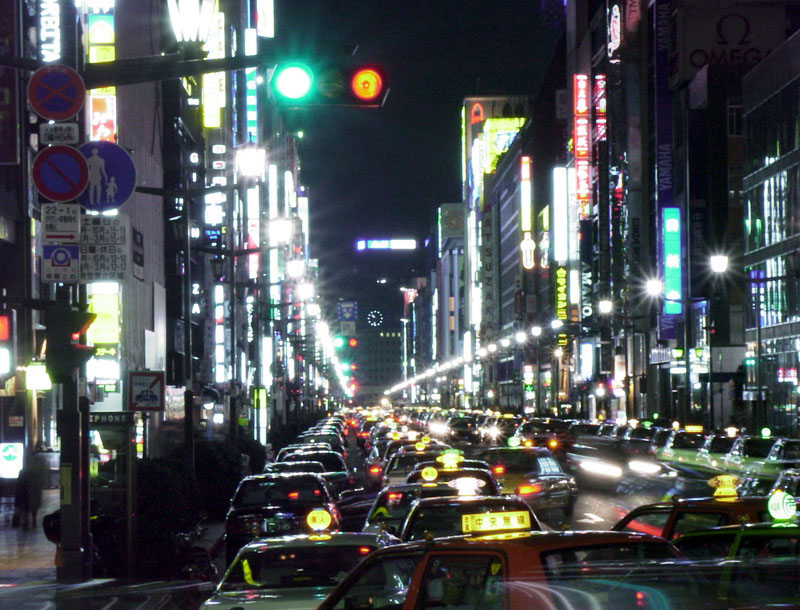
Wandering through Ginza on our last night was like being in Barcelona: a drink and a skewer here, a beer and a chicken ball there. First we went to a place that had exactly enough seats for all of us, and had some skewers of pork stomach, pork belly, and pork intestine, and really tender braised tripe, the leanest meat I’ve had so far on the trip, which says a lot about the richness of Japanese meats. I’ve really garnered an appreciation for meat fat here that I didn’t have before. I hope I impressed my chefs!Then off to a second place with a very strict mama-san (we didn’t have Jiro around to warm up the Mama-sans any more and we all missed him sorely) who spoke great English and served some tender chicken tail (a part of the chicken I never even knew existed), and some little peppers that were like Friuliano peppers that we’ve been seeing the whole trip. The place was literally built into the bridge that the city train ran over, so every time a train passed overhead (about every 2-3 minutes), it sounded like there was a taiko drum festival in our honor.
 After that was sushi: the first time we’ve eaten sushi since arriving in Japan (I’m not counting the sushi we ate in the kitchen at “Grand Chef Suzuki’s” tasting demo...as a waiter, and I think as a chef, food eaten standing up doesn’t count. Which is probably why we all pack a few more pounds than we might need to.). I think Sho-san really wanted to impress upon us the fact that JAPANESE CUISINE DOES NOT EQUAL SUSHI, and we got it. We really did. This trip has completely changed the way I look at food, though it’s too close to the trip to really say how just yet.
The best sushi (I thought) was the uni, which tasted like fresh, refined sea water, but super creamy. We also had a crazy red clam that was moving, and a white fish that was blowtorched and squeezed with lemon (TACHIUO, ‘scabbard fish’), not to be eaten with soy sauce. Also great and really fresh was a sardine.
One thing that's really interesting about this part of Ginza is the little streets and places full of character that when viewed from the outside lend this crazy party atmosphere to the streets. They’re all festively decorated and there are lots of people going in and out, and the energy of people eating and drinking and having a good time surrounds them all. Then, when you (literally) duck in, it’s a different world, and much more approachable. Real people, doing their after-work thing, and you could never even begin to try the food at all of them, though we did our best. We ate at least four meals a day, every day in Japan and most days we had a full dinner at one place and then went to another for a second dinner.
 It’s been really great listening to all of these chefs put their heads together and talk about different projects they could potentially do after being so inspired by this trip. Getting to see and eat all of the things we did, things that no ordinary tourist would ever even dream of doing, was an experience impossible replicate. As a travel writer, and someone who travels a lot even when NOT writing about it, it’s very rare that I get to just sit back and not make any decisions, and to have had a trip of this caliber without having planned any of it myself...I was REALLY impressed. And it was many of our first time to Japan.
The kinds of conversations the chefs were having about food almost seemed to make the world smaller. Think about it: cross-culturally, the heart and soul of food is the same everywhere. Things are skewered, they’re stewed, they’re stuffed. One thing we’ve all really liked about the back-room, family-style food we’ve been eating in Tokyo has been that that food has not taken the foreground. We’ve all been eating constantly, obvio!, but the kind of food we’ve been eating: simple, soulful, smoky (the “smoky” restaurants Sho-san referred to in an email early on was not regarding cigarettes, but rather the wood smoke filled with meat smells and pork fat that permeates everything), has not evoked the restaurant critic in any of us. Rather, it’s provided a great background for conversation and the ambiance of the evening and great fuel for creative thoughts that obviously revolve around food.
 After that was sushi: the first time we’ve eaten sushi since arriving in Japan (I’m not counting the sushi we ate in the kitchen at “Grand Chef Suzuki’s” tasting demo...as a waiter, and I think as a chef, food eaten standing up doesn’t count. Which is probably why we all pack a few more pounds than we might need to.). I think Sho-san really wanted to impress upon us the fact that JAPANESE CUISINE DOES NOT EQUAL SUSHI, and we got it. We really did. This trip has completely changed the way I look at food, though it’s too close to the trip to really say how just yet.
The best sushi (I thought) was the uni, which tasted like fresh, refined sea water, but super creamy. We also had a crazy red clam that was moving, and a white fish that was blowtorched and squeezed with lemon (TACHIUO, ‘scabbard fish’), not to be eaten with soy sauce. Also great and really fresh was a sardine.
One thing that's really interesting about this part of Ginza is the little streets and places full of character that when viewed from the outside lend this crazy party atmosphere to the streets. They’re all festively decorated and there are lots of people going in and out, and the energy of people eating and drinking and having a good time surrounds them all. Then, when you (literally) duck in, it’s a different world, and much more approachable. Real people, doing their after-work thing, and you could never even begin to try the food at all of them, though we did our best. We ate at least four meals a day, every day in Japan and most days we had a full dinner at one place and then went to another for a second dinner.

The kinds of conversations the chefs were having about food almost seemed to make the world smaller. Think about it: cross-culturally, the heart and soul of food is the same everywhere. Things are skewered, they’re stewed, they’re stuffed. One thing we’ve all really liked about the back-room, family-style food we’ve been eating in Tokyo has been that that food has not taken the foreground. We’ve all been eating constantly, obvio!, but the kind of food we’ve been eating: simple, soulful, smoky (the “smoky” restaurants Sho-san referred to in an email early on was not regarding cigarettes, but rather the wood smoke filled with meat smells and pork fat that permeates everything), has not evoked the restaurant critic in any of us. Rather, it’s provided a great background for conversation and the ambiance of the evening and great fuel for creative thoughts that obviously revolve around food.
Wednesday, March 25, 2009
Ichinokura Sake Brewery

Growing up in Northern California, one has a pretty good grasp of how wine is made. I was glad to have this background when visiting the Ichinokura Sake Brewery on our third day in Sendai City, because I would have felt a little lost in this huge plant. For many Americans, an introduction to sake came while dining at a sushi restaurant. A ceramic pitcher of hot, high-alcohol sake arrived, it washed down the sashimi and the nigiri in little cups, and we thought that all sake was the same. That’s a little like drinking a glass of white zinfandel straight from a box and thinking that all wines are pink and sweet.Sake (which is technically a beer, because it’s brewed and is derived from a grain), is often compared to wine because of its alcohol content (higher than a beer at around 16-20%) and because it works so well paired with food.
Sake’s flavor elements come from simple ingredients and a complicated process. The biggest factors that influence the finished product are water, rice, and yeast; other factors that have a hand in the sake’s flavor are weather and geography.
Sake is produced by fermenting rice.
 First, the rice is polished to remove the exterior of the rice grain (where protein and oil live), and the “pure core” of the rice is fermented. The more rice is polished away, the more high-quality the finished sake will be.
The rice is then soaked and washed, then cooked and fermented by adding koji and yeast (which change the starch into sugar, and then the sugar into alcohol) for several weeks. Koji is a mold that converts the rice’s starch into a simple sugar, which feeds one of many varieties of sake yeast to begin fermentation. The fermentation is often slowed by lowering the temperature; either by refrigeration or in snowy winter climates.
 After the rice ferments, it is pressed, and the liquids separate from the solids. Some sake has distilled alcohol added: this sake is called honjozo-shu, and is the cheap warm sake that many Westerners remember as their introduction to sake. After filtration, the remaining lees are removed (except in the case of nigori, where it is left in the sake to add a sweet taste and a creamy texture), and the sake is filtered and pasteurized (in most cases). Then, the sake rests and is diluted with water to lower the alcohol content and is bottled and drunk.
There are several different classifications of sake, with the most important being:
Junmai-shu. This is "pure rice sake," made from only rice, water and kōji, with no other additions.
Ginjo-shu is made from rice polished to 60% or less of its original weight. Sake made from rice polished to 50% or lower is called daiginjo-shu.

The term junmai (“pure rice sake”) can be added to ginjo or daiginjo, resulting in junmai ginjo and junmai daiginjo.
Sake can be served chilled, at room temperature, or heated, depending on the preference of the drinker, the quality of the sake, and the season. Hot sake is usually drunk in the winter, and high-grade sake like junmai daiginjo and junmai ginjo are not drunk this, because their delicate flavors and aromas will be lost through heating. Sake is often heated to hide the flavor of low-quality sake.
Aside from being served straight, sake can be used as a mixer for cocktails, like a “saketini” or a “sake bomb.”
Sake is best consumed within 2 or 3 hours after opening the bottle. It can be stored (in the refrigerator), although it is generally recommended to finish the sake within 2 days.
Needless to say, we drank a LOT of sake in Japan.
Current Obsession: MUJI
 CURRENT OBSESSION: MUJI
Japanese minimalism and perfect design meets sustainability
I’m currently obsessed with the minimalist eco-designs from MUJI, which translates from the Japanese into “No Brand.” I first discovered it in Sendai City on a food tour with a bunch of chefs. We’d been out to a super-homey yakitori (skewered meats roasted over an open charcoal grill) restaurant the night before, and our host had pointed out the groovy aprons that the yakitori chefs were wearing (in addition to dish towels wrapped around their heads, a standard here in Japan).Sho-san (our Japanese host, who lives and works in San Francisco) told us he’d take us to a place where we could get the same aprons for cheap, and the next day we went to MUJI, on the ground floor of a shopping mall (where it seems everything cool in Japan is located). MUJI is like a Japanese Ikea but with clothing: everything you could possibly need for home, body, and travel, but designed well, and it’s all made out of organic cotton and other sustainable fibers like bamboo.

At the end of the food tour, after our flight home from Tokyo to San Francisco was unexpectedly cancelled, we realized that we’d all brought just enough clothes to last us for an eight-day trip, not the nine-day trip we were suddenly faced with. Most of us had been wearing the same clothes juuuust enough to keep the funk at bay. The chefs didn't really care; a couple of them had bought a new pair of socks or a new t-shirt (stinky boys!) but I couldn’t face the thought of wearing the same clothes for the (x) day in a row.
As the chefs were tucking into yet another fried meal in a mall (this time in Tokyo), I noticed another MUJI. We'd blown through the first store in a whirlwind, picking out aprons and chopsticks with a determined speed, and while I had bought my aprons with the intent of wearing them as modified dresses when getting back to San Francisco (they’re cute and well-designed, two hallmarks of Japanese culture that I’ve discovered, and fell in love with this week), I hadn’t really taken a look at all that MUJI had to offer.
I could have stayed in there for much longer than the hour it took for the chefs to come wondering where the hell it was I’d got to. The clean lines and lack of any distinguishing labels brought to mind the understaded chic of Yoji Yamamoto, and the amount of things available was mind-bogglingly typical of the quality of goods that the Japanese consume on a regular basis. What drew me in first was a series of well-cut striped shirts, and a linen shirtdress with a pintucked tuxedo front fit just right.
 MUJI's prices are low: for $160 USD, I left there with the shirtdress and tights, a pair of grey leggings and a pair of striped socks, a striped longsleeve T, a pair of flat black booties with round toes and only four shoelace-holes that I don’t think we’d see the likes of outside of Japan, and those were only the clothes.
 MUJI also equipped me with a selection of travel accessories that I haven’t been able to find anywhere else and have been looking for in all one place for years. Sure, there’s the Eagle Creek packers and the Rick Steves luggage dividers and the racks of German-made ergo-design stuff that you’ll find in the outdoors-equipment stores, but MUJI’s toiletries bags and packing inserts are made of the finest, lightest-weight nylon that squeezes down into wispy little balls of nothing yet can zip tightly around six pounds of dirty laundry (I know, I squeezed all mine in the second I got my brown-paper recycled MUJI bags back to the hotel’s concierge, where all of my luggage had been in stasis since we returned from our futile journey to the airport the day before).
Maybe I’m just an organizational freak, but a frequent traveler often has their rituals and their weird little tics that they can’t live without: mine are an oversized pashmina scarf, a series of earphones, eye-masks, and writing materials and several little bottles of in-air moisturizing liquids that keep me from suffering and prevent jet-lag once I’m on the ground. All of these are now neatly arranged into easily accessible little corners of my purse in black-and-white checked bags that weigh under an ounce each and are designs worthy of the Comme des Garçons label.
There’s a few MUJI stores in New York City, but the across-the-pond prices have inflated and there was just something about buying it all in Japan that really satisfied that “I got something that’s completely utiliarian and that I can’t find anywhere else in the world” itch.
Wait, am I the only one who has that itch?
Maybe I’m just an organizational freak, but a frequent traveler often has their rituals and their weird little tics that they can’t live without: mine are an oversized pashmina scarf, a series of earphones, eye-masks, and writing materials and several little bottles of in-air moisturizing liquids that keep me from suffering and prevent jet-lag once I’m on the ground. All of these are now neatly arranged into easily accessible little corners of my purse in black-and-white checked bags that weigh under an ounce each and are designs worthy of the Comme des Garçons label.
There’s a few MUJI stores in New York City, but the across-the-pond prices have inflated and there was just something about buying it all in Japan that really satisfied that “I got something that’s completely utiliarian and that I can’t find anywhere else in the world” itch.
Wait, am I the only one who has that itch?
Subscribe to:
Posts (Atom)